Your Corner Coffee Shop Is Doing More for Your Career Than LinkedIn
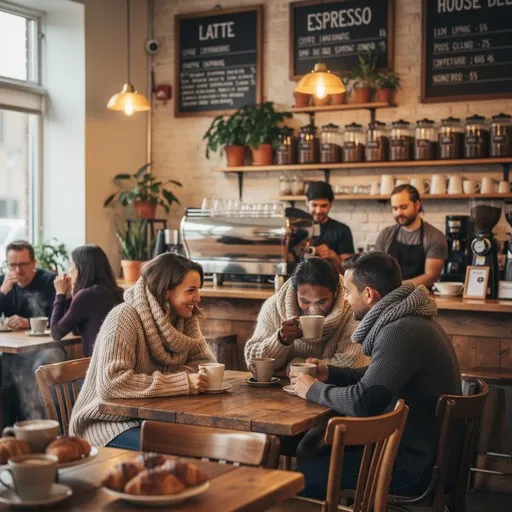
Photo: cozy neighborhood coffee shop interior people talking, via images.stockcake.com
Let me make an unpopular argument: the most valuable professional networking tool in your life probably has a pastry case and a slightly sticky floor.
We've been sold a story that luck and opportunity come from optimization — the perfect LinkedIn headline, the curated feed, the strategic follow. Meanwhile, the actual data keeps pointing somewhere much less glamorous: the dog park. The hardware store. The bar where the bartender knows your order. The places sociologists call third places, and the casual acquaintances researchers call weak ties — which turn out to be anything but weak.
The Weak-Tie Miracle
In the 1970s, Stanford sociologist Mark Granovetter published a finding that still rattles the networking-industrial complex: most people find jobs through acquaintances, not close friends. Not your best friend, not your spouse — the person you chat with at the gym. The neighbor you wave to.
Why? Your close friends occupy the same world you do. They know the same openings, the same people, the same gossip. Your weak ties live in different networks entirely. When the guy at the dog park mentions his company is hiring, he's handing you a bridge to a world you'd never otherwise see.
And here's the kicker: weak ties only work if you actually have them. Which means the loneliest thing you can do for your career isn't skipping a conference — it's never becoming a regular anywhere.
Third Places: Where Luck Loiters
Ray Oldenburg, the urban sociologist who coined the term, described third places as the spots that are neither home nor work — the barbershop, the café, the bar, the barbershop-adjacent bodega. They share a few magic traits: they're cheap or free, conversation is the main activity, and everyone shows up as a regular, not a résumé.
That last part matters more than it sounds. On networking apps, every interaction is transactional and slightly performative. At your neighborhood spot, familiarity compounds quietly. The barista learns your name. The guy who's always doing the crossword starts nodding at you. Then one day, a conversation just... happens. No elevator pitch required.
Opportunity doesn't announce itself. It leaks out of casual conversation — a mention of a project, a complaint about being understaffed, a "you'd be great at this." Those leaks only reach you if you're physically present when they happen.
The Regular's Playbook
Becoming a neighborhood regular is one of the few luck strategies that requires almost zero talent. Just repetition:
Pick one spot and haunt it. Same coffee shop, same time, a few times a week. Familiarity does the heavy lifting; you don't have to be charming, just present.
Do the low-stakes small talk. Weather, dogs, the line being long. It feels pointless. It is the opposite of pointless — it's the on-ramp to every relationship that ever mattered.
Learn three names. The barista, one fellow regular, the shop owner. Names turn strangers into acquaintances, and acquaintances are the whole engine here.
Say yes to the weird invite. The trivia team that needs a fourth. The neighborhood cleanup. Half of every lucky break in history started as someone saying, "Eh, sure, why not."
But I'm an Introvert / I Work Remote / It's Cold Out
All valid. Start embarrassingly small. One visit a week. Headphones on is fine — just be a fixture. Regulars drift into each other's orbits eventually; that's the whole mechanism.
And if your neighborhood is genuinely short on third places, libraries, community gyms, farmers markets, and volunteer shifts all run on the same fuel: repeated low-pressure exposure to the same humans.
The Luckiest Thing You Can Do Is Show Up Somewhere
Here's my honest opinion: we've outsourced serendipity to algorithms, and the algorithms are terrible at it. They show us people exactly like us. Luck lives in the friction of difference — the retired teacher, the guy launching a food truck, the woman who just moved from Denver.
Your neighborhood is full of them. They're already there, waiting in the same line you are.
So this week, skip the scroll and go stand in a room with other humans. Order the usual. Complain about the weather. You have no idea which of these small talk exchanges turns into something — and honestly, that's the whole point.