One Cheer Changes Everything: The Surprising Ripple Your Celebration Sends Into the World
Picture this: You're standing in line at your favorite coffee shop and the barista mentions — almost apologetically — that she just got into nursing school. The person ahead of you turns around, eyes wide, and says, "That is genuinely incredible. You should be so proud." Nothing dramatic. No confetti. Just real, unhurried enthusiasm from a total stranger.
Now imagine you're that barista. You've been second-guessing the acceptance for weeks — wondering if you're smart enough, tough enough, ready enough. And then a stranger, someone with zero skin in your game, treats your win like it actually matters.
That's the luck ripple effect. And it's more powerful than most of us realize.
What Psychologists Call "Emotional Contagion" (And Why It's Really Just Catching Someone's Good Vibes)
There's a well-documented concept in social psychology called emotional contagion — the idea that feelings spread between people the way a cold does, just a lot more pleasantly. When you witness someone expressing genuine joy, your mirror neurons fire. Your brain, in its beautifully weird way, begins to simulate that emotion in real time.
This isn't metaphor. It's measurable. A 2014 study published in PLOS ONE analyzed nearly 700,000 Facebook users and found that exposure to positive emotional content caused people to post more positively themselves — even without direct interaction. The happiness traveled. It jumped from person to person like a spark looking for dry grass.
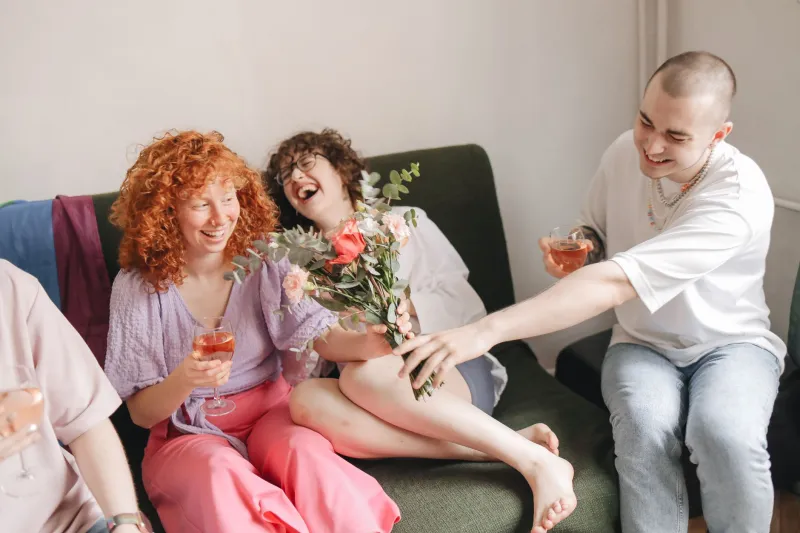
Now apply that to real life, where the stakes are higher and the interactions are face-to-face. When you celebrate someone's win out loud — with your whole chest, not just a polite nod — you aren't just being nice. You're introducing a new emotional frequency into that person's day. And they carry it forward.
The Invisible Chain Reaction You're Already Part Of
Here's something that might shift how you move through your day: most of the luck ripples you create are completely invisible to you.
You have no idea that the coworker you high-fived after her presentation went home and finally sent that novel query letter she'd been sitting on for two years. You'll never know that the neighbor kid you cheered at his Little League game decided — right then, on that dusty field — that maybe he was an athlete after all. You won't get a notification when the friend you celebrated for her promotion walked into her next negotiation with a completely different posture.
But it happened. It happens constantly. The problem is we wildly underestimate our own influence because we don't get to see the downstream effects.
Dr. Nicholas Christakis and James Fowler, whose research on social networks became the basis for the book Connected, found that happiness spreads through social networks up to three degrees of separation. Meaning: your good energy doesn't just affect the person you're talking to. It affects their friends. And their friends' friends. A single genuine celebration can theoretically reach people you've never met.
That's not woo-woo thinking. That's network science.
Why "Authentic" Is the Key Word Here
Not all celebrations are created equal, and people can absolutely tell the difference. Hollow congratulations — the kind delivered while already looking at your phone — don't create ripples. They barely create a splash.
What moves people is witnessed joy. When someone stops what they're doing, makes real eye contact, and treats your accomplishment like it deserves to be treated, something shifts in the recipient's nervous system. Their cortisol drops. Their confidence inches upward. Their internal narrative about what they're capable of gets quietly rewritten.
Researchers at the University of California, Santa Barbara found that when people feel genuinely celebrated — not just acknowledged, but celebrated — they're significantly more likely to pursue ambitious goals afterward. The win becomes evidence. And evidence is a much stronger motivator than encouragement alone.
This is why hollow hype doesn't work the same way. "Good job" said to the floor is not the same as "Wait, you did what? Tell me everything." One is noise. The other is fuel.
Small Moments, Seismic Shifts
The beauty of the luck ripple effect is that it doesn't require grand gestures. You don't have to throw a party or write a speech. The moments that change trajectories are almost always small ones.
- A text that just says, "I saw your Instagram post and I genuinely love that you went for it."
- Stopping at a coworker's desk to say, "I heard about your project. That's a big deal."
- Clapping a little too enthusiastically at your friend's open mic night.
- Telling a stranger's kid, "Wow, you're really good at that."
Each of these takes maybe fifteen seconds. Each of them can stick in someone's memory for fifteen years.
And here's the kicker — it circles back. People who feel genuinely celebrated tend to celebrate others more freely. It's a loop. You start one end of it, and the luck just keeps traveling.
How to Become a Ripple-Maker Starting Today
If you want to be the kind of person whose presence quietly upgrades everyone around them, the practice is surprisingly simple:
Actually pause. When someone shares good news, resist the urge to immediately pivot to your own story or start offering advice. Just be in their moment for a beat.
Be specific. "That's amazing" is fine. "I know how long you've been working toward this and I think it's incredible that it finally happened" is a ripple-maker.
Say it out loud. Internal appreciation is kind. Expressed appreciation is transformative. Don't let the celebration stay in your head.
Celebrate the small stuff too. You don't have to wait for promotions or engagements. Someone finishing a hard week deserves a "You made it." Someone trying a new hobby deserves a "I love that you're doing that."
The Lucky Truth About Celebrating Others
There's one more twist worth mentioning: people who celebrate others generously tend to report feeling luckier themselves. Not because the universe keeps score (though who knows, honestly), but because celebrating others trains your brain to notice and amplify the good. You become someone who looks for wins. And people who look for wins — in themselves and in others — tend to find them.
So the next time someone shares a win with you, no matter how small, treat it like it matters. Because it does. And your reaction to it might just be the invisible nudge that changes everything for them — and maybe, quietly, for you too.
That's the luck ripple effect. And you can start one anytime.